Hunting with the Ju/'hoansi in the Kalahari: A co-created VR gesture application
The Donkerbos Ju/'hoansi community in Namibia collaborated with researchers from Namibia University of Science and Technology & Aalborg University to create a VR application aimed at preserving their indigenous language and knowledge. The application told a traditional hunting story, narrated by an elder and demonstrated by both an elder and youth, capturing the community's rich oral traditions. The VR experience served as a crucial tool for preserving the Ju/'hoan language, with all instructions and demonstrations delivered in the community's native tongue.

N/a'an ku sê Primary School
A virtuous cycle for language, culture, education and development
Lets dance /Hi//Ka//Kusi with non-player character Ju/'Hoansi women in Virtual Reality
The Donkerbos Ju/'hoansi community has co-created a Virtual Reality (VR) experience of their traditional dance, /Hi//Ka//Kusi, a dance of rain, food, and prosperity, accompanied by a song of laughter. This dance, primarily performed by the women of the community, embodies their cultural values of joy, unity, and gratitude. The VR experience preserves and promotes the Ju/'hoan language, as the song and interactions are presented in the community's native tongue, ensuring the survival of their linguistic traditions. It also safeguards the indigenous knowledge embedded in the dance, capturing its significance as a communal celebration and cultural expression. Through this collaborative effort, the community has created an immersive way to document and pass on their heritage to future generations while maintaining its cultural authenticity.
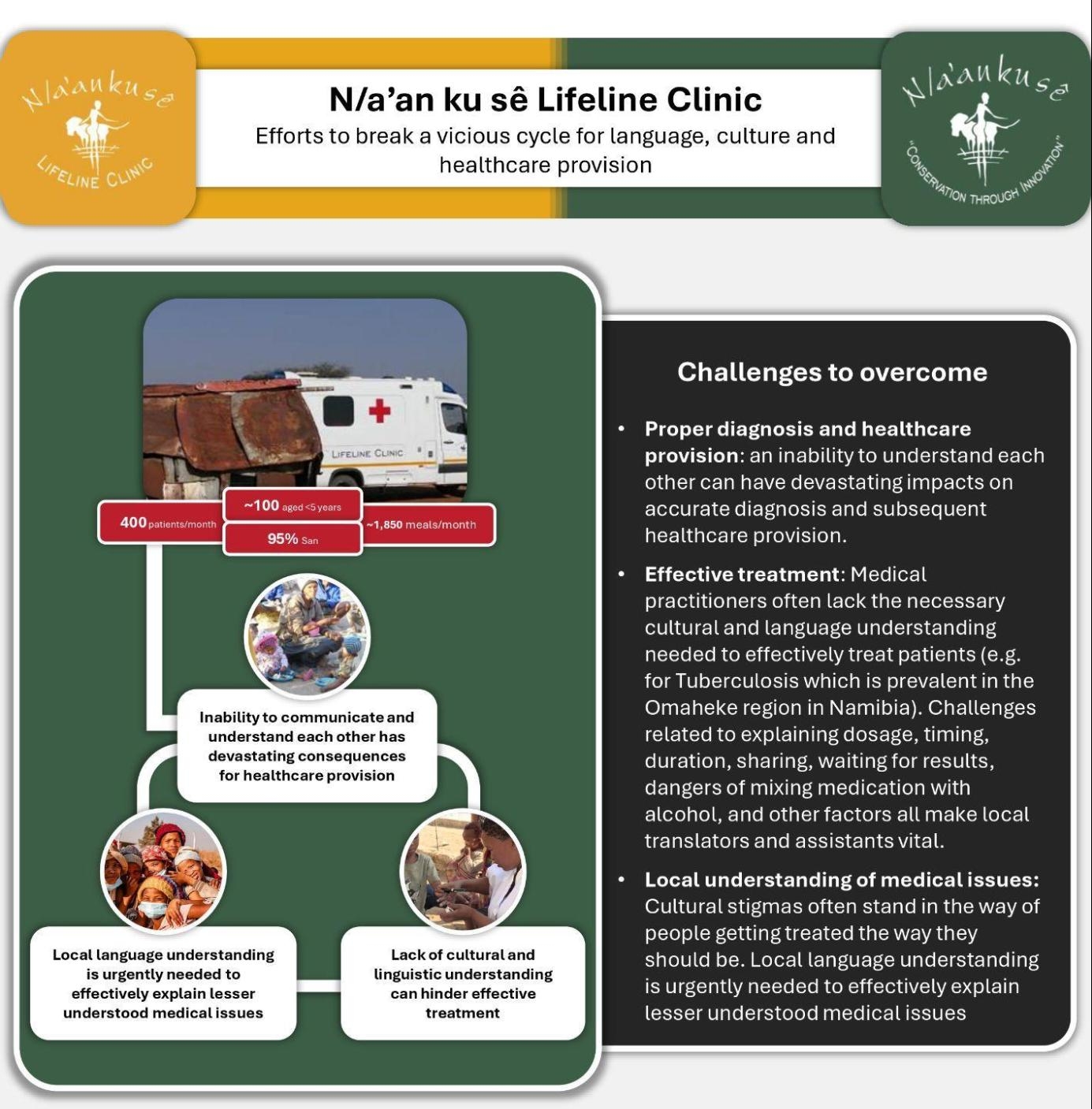
N/a'an ku sê Lifeline Clinic
Efforts to break a vicious cycle for language, culture and healthcare provision
Ju/'hoansi San Community Starlore Astro Tourism Development at Nyae Nyae Conservancy
Indigenous people worldwide have observed and theorised the night sky since earliest times, developing knowledge systems that reveal complex relationships between celestial phenomena, ecological patterns, and cultural identity. San communities have developed insights into alternative observations to the Greek and the Greco-Roman scientific domain, enriching our understanding of the cosmos and the interconnectedness of life. Today, such knowledge continues to guide agricultural practices, migrations, community rituals, wayfinding, and self-worth. Astro-tourism is gaining increasing popularity globally as a niche tourism product. Categorized as a form of eco-tourism, astro-tourism involves travelling to destinations with minimal light pollution in dark sky locations, appreciating the scientific knowledge of astronomy, and visiting astronomy-related sites. Starlore activities require minimal infrastructure and thus have little impact on the environment, so they are relatively low-cost, easy, and sustainable. Astro-tourism predominantly occur in dark sky areas, astro-tourism provides a rich opportunity for rural community development in Namibia, including preserving indigenous star lore. For these reasons, astro-tourism has been found to support several of the United Nations' Sustainable Development Goals, including poverty alleviation and community building and socioeconomic development in Namibia.

Ju/'hoansi Community broadcast in Donkerbos
The Community Broadcast Project is a transformative initiative aimed at empowering the Donkerbos community by creating podcasts through content creation platforms like Anchor Network. The project seeks to address socio-political challenges through sharing oral traditions and discussing issues of a local community with a wider rapidly transforming society. The primary goal is to provide an alternative to traditional journalism, enabling community members to share their content and have a meaningful voice in the public sphere. The community broadcast platform, an integral part of the project, allows individuals to create and share various media content, including audio, video, pictures, and text. This platform serves as a means to disseminate cultural heritage practices, indigenous knowledge, everyday stories from the bush, and media political statements, engaging a wider audience in a dialogue for socio-cultural justice and safeguarding cultural heritage, including indigenous languages.